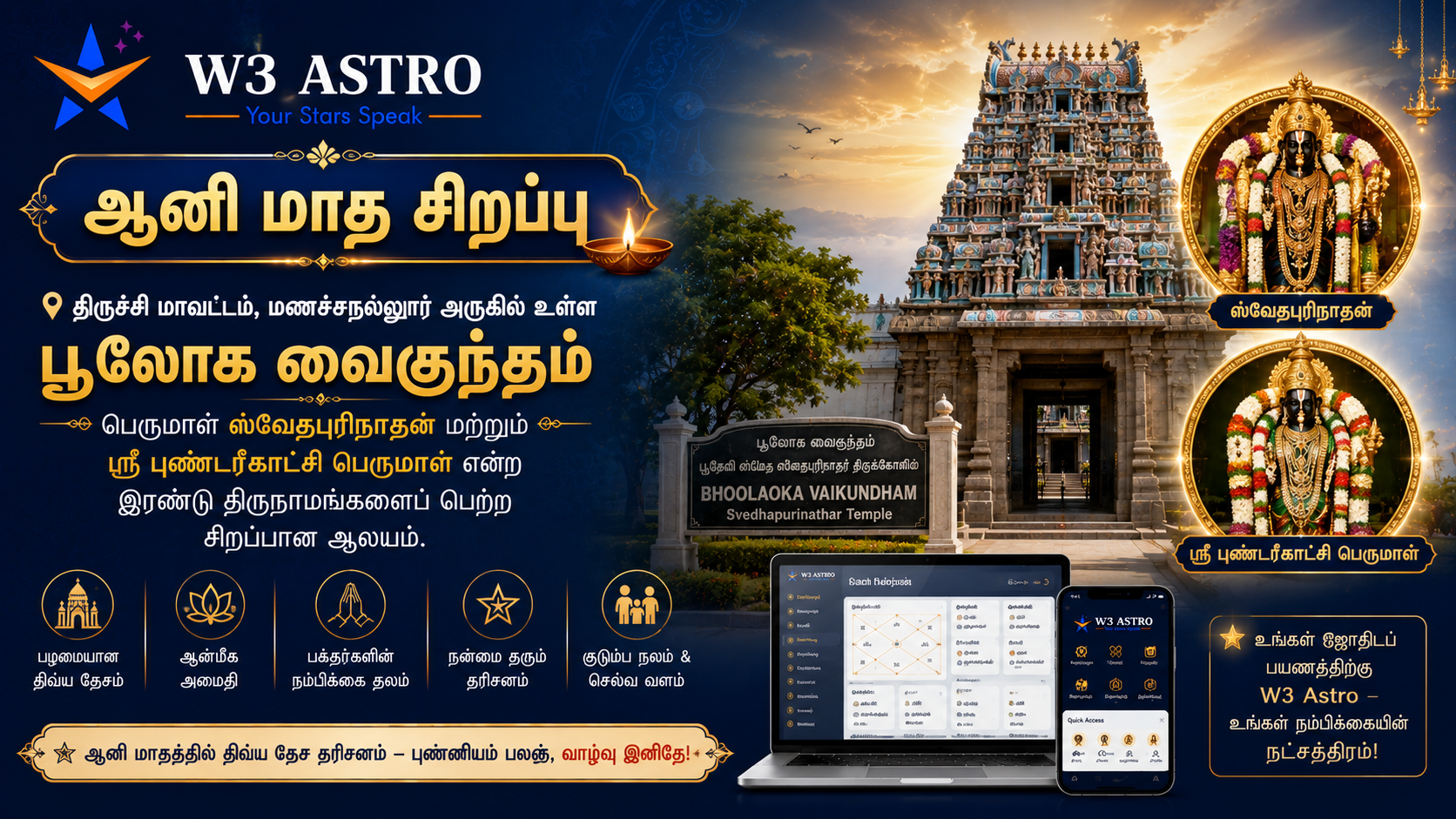
An Ancient Shrine Older Than Srirangam
Thiruvellarai Pundarikakshan Perumal Temple is located near Manachanallur in the Tiruchirappalli district and is regarded as one of the oldest Vishnu temples in the region — older even than the famed Srirangam temple.
The temple is affectionately known as 'Boologa Vaikuntham', meaning the Earthly Vaikuntha, signifying that a visit here is equivalent to experiencing the abode of Lord Vishnu itself.
Its antiquity and sanctity have made it a cherished destination for devotees seeking the blessings of Lord Maha Vishnu in his form as Pundarikakshan Perumal.
The Rare Tradition of Two Sacred Gateways
Unlike any other temple, Thiruvellarai has two separate main entrances — a feature unseen in most Vaishnava or Saiva shrines across Tamil Nadu.
The Tamil calendar year is divided into two Ayanams (solar phases): Uttarayanam (the sun's northward movement) and Dakshinayanam (the sun's southward movement).
In keeping with this celestial rhythm, only one gateway of the temple is opened during each Ayanam — the Dakshinayana gateway remains open from the Tamil month of Aadi through Margazhi, while the Uttarayana gateway is open from Thai through Aani.
The Legend of Sweta Varaha and the Names of the Lord
Temple history recounts that Lord Vishnu appeared before King Sibi Chakravarthi in the form of Sweta Varaha (the White Boar), and from this divine vision the deity came to be known as 'Swetapurinathan'.
This sacred connection has also given the temple the name 'Swetagiri'. The presiding deity here is uniquely worshipped under two revered names — Swetapurinathan and Sri Pundarikakshan Perumal.
In a separate shrine within the temple complex resides the Goddess Sengamalavalli Thayar, while the processional deities (Utsavar) are worshipped as Senthamarai Kannan and Sri Pankajavalli Thayar.
A Temple That Removes the Sins of Humankind
It is believed that we human beings, knowingly or unknowingly, may commit certain wrongs in the course of life. Yet even a single visit to this Earthly Vaikuntha — Thiruvellarai — and a darshan of its sacred gopuram is said to wash away these sins.
Devotees believe that such a visit allows one to live the rest of life surrounded by prosperity (Aiswaryam), and that after death, the soul attains Vaikuntha, the abode of Lord Vishnu — a belief held to be true by generations of devotees.
It is considered especially meritorious to visit this temple at least once during the Ayana period corresponding to one's own birth — that is, during the solar phase (Uttarayanam or Dakshinayanam) in which one was born.
Worship for the Removal of Pithru Dosham
According to one's horoscope (Jathagam), worshipping at this temple during the Tamil month of one's birth is believed to remove all sins and obstacles.
Those affected by Pithru Dosham (ancestral afflictions) are advised to visit during the Tamil months of Aadi and Purattasi, enter through the Dakshinayana gateway, offer worship to Perumal, and present a thulasi garland — this practice is believed to relieve the dosha.
This combination of the temple's sacred geometry and the devotee's sincere worship is regarded as a powerful remedy passed down through generations.
Worship During Uttarayanam for Wealth and Prosperity
To overcome economic hardship, financial obstacles, and poverty, devotees are advised to visit and worship during the Uttarayana period — this is believed to bring an increase in wealth (Selva Valam) and overall prosperity (Aiswaryam).
It is considered especially auspicious for those born in the Tamil months of Aani and Purattasi to visit and worship at this shrine.
Furthermore, individuals undergoing Budhan Dasa or Budhan Bukti, as well as those born under Dhanusu Lagnam (Sagittarius ascendant) or Meena Lagnam (Pisces ascendant), are considered especially suited to seek the blessings of this sacred temple.